



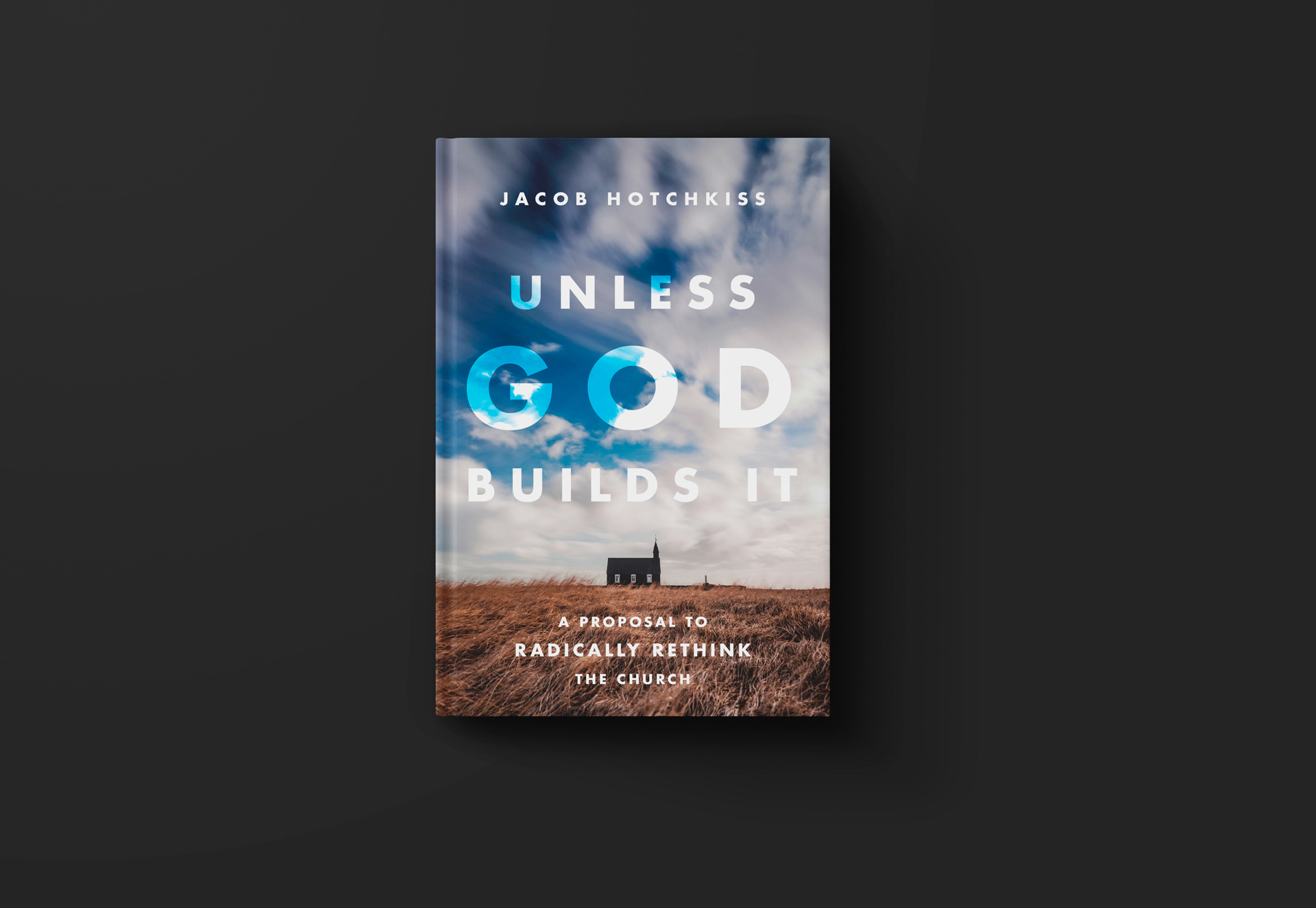
Welcome to Part 2 of the weekly release of my book, Unless God Builds It: A Proposal to Radically Rethink the Church.
In the previous part, I shared my personal journey of wrestling with the traditional church system, and why I eventually had to admit that despite my best efforts, it was leaving me spiritually empty. Today, I share what life has been like since leaving the institution for a simple “house church” community, and clarify why my critique of the traditional model isn’t about elitism, but about finding a more fruitful way to grow together.
(If you have already read the book and do not wish to receive these weekly emails, simply click ‘Unsubscribe’ at the bottom of this email. It will only unsubscribe you from the Book section, and you will still receive my normal weekly newsletter!)
Institutional Vs. Organic
This path that I’m on today started (officially) in December 2019, when I left my job as a pastor at a large church to start a church in my home. Part of the vision for this church is that whenever we outgrow someone’s living room, we multiply—appointing someone to lead the next church in their home, resulting in a network of “house churches.”
Funny enough, before my house church ever multiplied itself, God joined us with another house church that was started independently by a man named Jonathan. “The two became one,” so to speak, so neither he nor I can say that we started it ourselves—and what a blessing that is! It is God’s church, and Jesus is our Apostle (see Hebrews 3:1), the chief “Shepherd and Overseer of [our] souls” (1 Peter 2:25, cf. 5:4).
People often ask us what the name of our church is. We don’t have one. We also aren’t part of a denomination. We are just a group of sincere believers doing our best to follow the commands of Jesus, to know him, to love one another, and “to grow up in every way into him who is the head, into Christ” (Ephesians 4:15). We do not attend any other churches (as if we would need to in order to get something that we’re not getting from each other). We’re not merely a “small group,” “life group,” or whatever kind of group-thing that churches implement to foster deeper relationships. We are a bona fide church—a thriving and self-sustaining body of believers without the systems, programs, buildings, budgets, bureaucracies, and activities that most Christian communities depend on.
We don’t sit around lamenting our former church experience (like many house churches are accused of doing). We don’t identify with “church hurt” or cynicism. We don’t bash our brothers and sisters who do it a different way. Quite honestly, we hardly ever talk about the churches we came from. Our fellowship has always been forward-looking, and it is filled with what God is doing in each of us today.
I am aware that this kind of thing tends to scare people. The term “house church” alone makes people’s alarm bells go off. It may even cause you to question my credibility. (It wouldn’t be the first time.) Where’s the structure? Where’s the authority? Where’s the accountability? Where is the long line of tradition that we can trust? How do we keep things from going off the rails? Etc.
To be sure, I have not embarked on this venture naively but by faith (and, I believe, with some important revelation that informs my faith). I am not blind to the dangers, criticisms, and fears surrounding the sort of “organic” community that we are building compared to the institutions that people are familiar with. Regarding the church model that we use, I don’t think that I’ve ever been presented with a concern that I hadn’t already weighed heavily and found a biblical resolution for. With that in mind, I ask you the favor, once more, of suspending judgment until you have read through this book entirely.
Six years in, we now have five house churches meeting separately, about 12-25 people per house, and we come together every six weeks for a corporate gathering. (There is, of course, much life that we share between us throughout the week, as well.) These six years have been the best years of my life, bar none—more fruitful, more restful, more life-giving, with more meaningful fellowship, more clarity, more understanding, more purpose, more of everything that the Christian life is supposed to be. This is what I hope to share with all my brothers and sisters in Christ.
That is not to say that it has been perfect or without struggle—not even close—but that it has been immeasurably better. This is, in part, due to the revelation of the gospel that God gave me (and many of us) in 2020, which I have written extensively about in my book, No Longer I: The Life-Changing Power of Simply Believing the Truth, and which I’ll cover in Chapter 5: The Gospel. However, another significant reason for this dramatic shift toward a more positive Christian experience has been the uncommon way that we have learned to function as the Body of Christ.
There is still a lot we haven’t figured out, and that is perfectly fine with me. As I said, we are on a journey, and God is teaching us as we go. I fully expect that I will need to revise this book in years to come, but I have come to a point where it is simply too good not to share what we’ve learned and invite others into the kind of life we’ve discovered.
I am a practitioner by nature. God showed me when I left my former church that it wouldn’t do any good for me to try to teach these ideas from the stage. I needed to live it and learn it myself, to prove that it is not only possible but far better, and then, after learning a few things myself, to invite others into it. All that to say, I am eager to share something truly beautiful with you.
I honestly cannot imagine returning to the “institutional” church model. I cannot unsee what I have seen. For so many reasons, which I will explain in this book, that old system makes the spiritual life more difficult and complicated than it was ever supposed to be. Intended to support spiritual growth, I have come to believe that it often does the opposite.
It does okay at making babies (spiritually speaking), and maybe even growing them into toddlers. But overall, it’s sort of like a preschool. At some point, we have to realize that spending more time there isn’t growing us up; it’s keeping us from growing up. Similar to how a 2nd or 3rd-grader might feel while being forced to play pre-school games, those who have moved beyond spiritual toddlerhood know—often with a quiet ache—that there must be more.
I say all of this (God as my witness) without a trace of cynicism or anger in my heart toward the Church. I do not carry any sour feelings towards those brothers and sisters of mine who do not share the same convictions that I do and who still function in the traditional church model. Additionally, I do not attribute the poor state of the Church to apathy, lethargy, or anyone’s unwillingness to pursue God. I attribute it, rather, to the result of a system that most of us were more-or-less born into and ideas that we were bottle-fed from the womb, neither of which was made by God but by man (in the name of God). This distortion is exactly what the enemy hopes for—that we would settle for a man-made version of something that only God can build.
Spirit of Elitism?
As I express my contrarian viewpoints and/or favorable view of my own church throughout the book, I would ask that you not conflate this with me having a spirit of elitism. An elitist thinks to himself, “I am better than they are.” But I do not think I am “better” than you, nor that my church is “better” than yours. Rather, I think that my church’s ways (specifically the ones outlined in this book) are more effective and closer to God’s design than the ways of the traditional church system that most Christians still operate in.
And let’s be honest, most people who operate within the traditional church model think that its ways are better, or else they wouldn’t be choosing to do things that way. So we all have preferences, and at the end of the day, those preferences expose what we think is more preferable. That’s not “elitism”; it’s just “having a position.”
Assuredly, we can hold different positions about how the Church should function without looking down our noses at one another. Even more so, if we actually desire what’s best for one another and the whole Body of Christ, we should share our convictions with each other and work through them together. But the moment we start blindly accusing each other of elitism, we’ve stopped giving one another the benefit of the doubt, and we’ve closed ourselves off from the ability to build each other up.
God’s Design for All
Lastly, before we begin, I want to be very clear that “house church” is not the silver bullet. It was only the natural outgrowth of the convictions that the Lord began stirring in my heart a number of years ago, proving itself to be wonderfully biblical and surprisingly practical. I think it will be the same for some of you, but not necessarily for others. And that’s okay.
As such, house church is not the explicit subject of this book. Please read that again, and don’t forget it! Though I will not shy away from talking about the uniquely strategic value of house church, it will be up to you and God to determine how you apply the concepts we cover within your own community, even if you use a different model.
As for these concepts we’ll cover, let’s think of each chapter as a core design feature in God’s Temple, that is, the Church. God is the Great Architect, and if he built every church in the world exactly like he wanted to, while we should expect quite a lot of variance, we should also expect some things to be the same everywhere. To be sure, in God’s blueprints for the Church, there are things that apply to every church all around the world, without exception. These shared design elements are the non-negotiables, apart from which a church is unable to function properly and achieve its greatest heights.
Nearly every Christian would agree that among these core design features are things like teaching the Bible, gathering every week, using our gifts to serve one another, etc. In this book, I will by no means attempt to address all of these, for many of them are already broadly established in the Body of Christ. I will, however, in each chapter, make a case for an essential design feature that I believe is still missing from most churches today. If these are adopted, I argue that they will radically reshape and amplify nearly every Christian’s experience of God, one another, and his kingdom on this side of heaven, which is another way of saying that we will bear more fruit and hasten the coming of Jesus Christ (2 Peter 3:11-12).
Be prepared, though, that some of these concepts may seriously challenge the way you or your church has functioned. They may lead you to feel overwhelmed and unsure how to proceed in the face of many obstacles. I will do my best to provide you with practical applications when I can, but a lot of them pertain specifically to the house-church model. Therefore, if you don’t go that route, then in some cases, I may not have a clear application for you. But I know who does!
In the case that you find yourself agreeing with the concepts but not knowing how to apply them in your context, I encourage you not to give up. If these design features are truly necessary, and if God truly wants you to stay in your particular church setting, then he will provide a way for you to help move your church in that direction. Don’t abandon God’s design just to relieve yourself of consternation, but instead, cleave to God’s design and wrestle with him through the consternation until he gives you the wisdom you need. He is faithful.
Ultimately, whichever way the Spirit ends up leading you—toward house church or otherwise—I remain confident that there is treasure for you and your church within these pages. I pray that the following chapters will lead you, above all things, to entrust God with building his Church, no matter the cost.
< Previous Part | Table of Contents | Next Part >
Questions for the Comments:
When you hear the term “house church,” what are the first thoughts or fears that come to mind?
What “core design features” do you believe are non-negotiable for a church to function properly according to God’s blueprint?
Want to discuss these topics with other like-minded believers? We regularly explore the theology of the Church, discipleship, and spiritual growth in our monthly Community Calls. It’s a great place to connect—upgrade to a paid subscription today to get access!
Like what you’re reading? You don’t have to wait for the next part. You can read the entire book right now in paperback, ebook, or audiobook format on Amazon. Buy ‘Unless God Builds It’ Here
In Christ,
Jake