



I want every follower of Christ to have full confidence in their salvation, from beginning to end.
I myself have full confidence in my salvation, from beginning to end.
This means I don’t doubt that:
I am saved (i.e., have the Holy Spirit, have become one with Christ)
I am being saved (i.e., healed, transformed, delivered, sanctified, more and more each day by the grace of God)
I will be saved to the uttermost (i.e., raised from the dead, perfected in glory, given immortality and a resurrected body, provided full adoption, inheritance, and entrance into his glorious kingdom, etc.).
There are many ways to say these things, but the point is, my hope is unwavering that God will not give up on me. He won’t let me go. His love will not fail me. Nothing can thwart his eternal purpose for my life.
But this confidence isn’t empty. It is based on something very important (not what most Christians think), something measurable, which we’ll get to shortly. And without that basis, it would be not only very difficult, but foolish, to have it. In this article, I hope to show you how simple, yet how profound, this really is.
As a quick sidenote, I’d like to plug my new book, Unless God Builds It: A Proposal to Radically Rethink the Church.
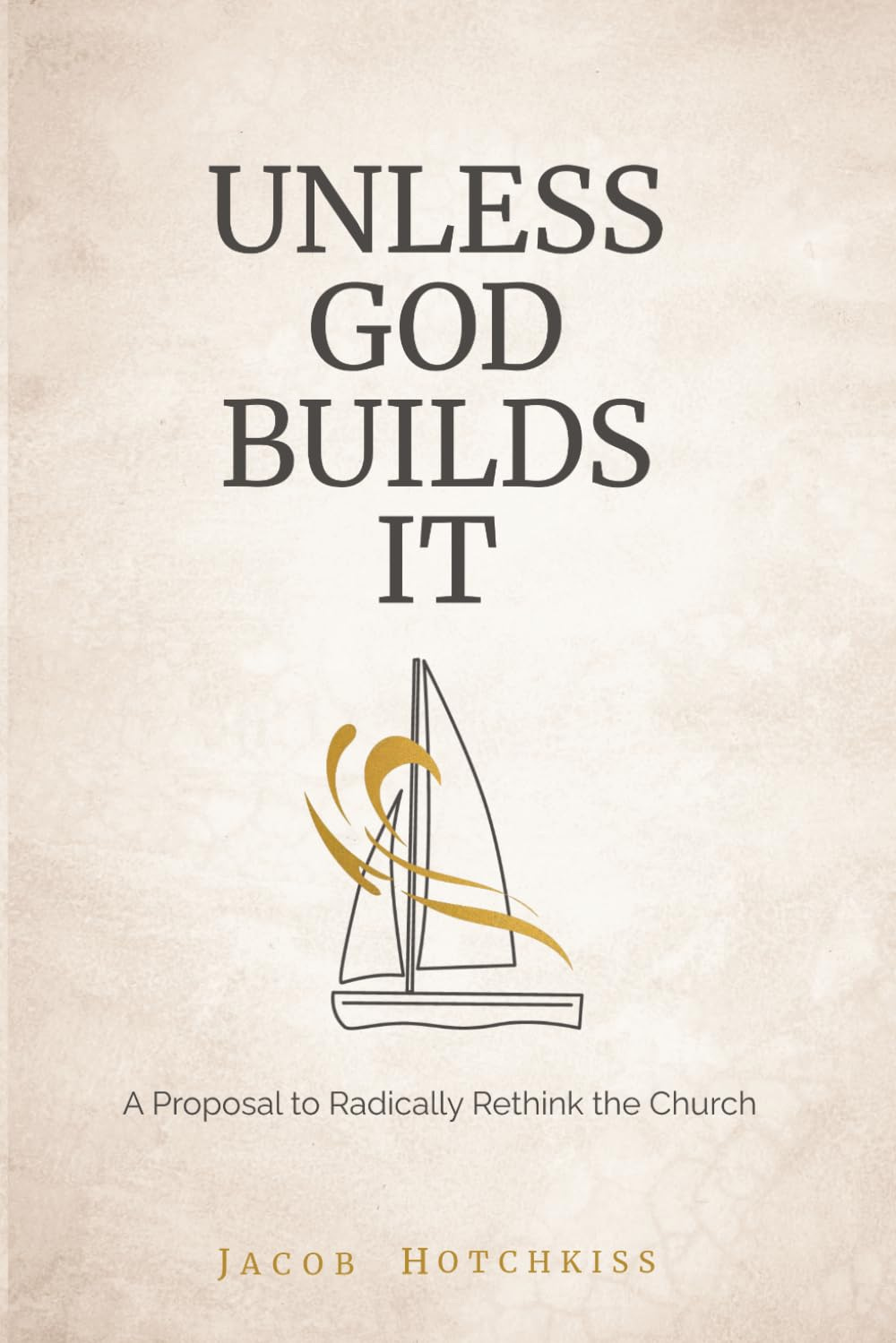
If you sense that there’s got to be a better way of building the Church, you’re not wrong! Grab yourself a copy and see how God intends for his people to function for maximum fruitfulness. Buy here: https://a.co/d/06qjjR2P
In the Christian journey, assurance of our salvation is extremely important. It is part of the essence of trusting in God, part of the gift he has given us, which comes with unshakeable peace and indescribable joy. It is also the cure to the fear of death, by which we were enslaved to sin (see Hebrews 2:15).
Hence the many scriptures which point to this reality, including a few below:
I am sure sure that [nothing] in all creation will be able to separate us from the love of God in Christ Jesus our Lord.” (Romans 8:37-39)
All that the Father gives me will come to me, and whoever comes to me I will never cast out. (John 6:37)
My sheep hear my voice, and I know them, and they follow me. I give them eternal life, and they will never perish, and no one will snatch them out of my hand. My Father, who has given them to me, is greater than all, and no one is able to snatch them out of the Father’s hand. (John 10:27-29)
In him you also, when you heard the word of truth, the gospel of your salvation, and believed in him, were sealed with the promised Holy Spirit, who is the guarantee [or down payment] of our inheritance until we acquire possession of it, to the praise of his glory. (Ephesians 1:13-14)
And I am sure of this, that he who began a good work in you will bring it to completion at the day of Jesus Christ. (Philippians 1:6)
This is obviously an important truth that God wants his children to know and believe!
However, many Christians struggle to “put it on” because of the many other verses that warn of falling away, falling asleep, returning to sin, being cut off, etc. Christians rightly intuit that our confidence in God’s promise to carry us through to the end is not something to simply presume (or take for granted) without an adequate foundation. But what is that foundation?
Moreover, it obviously doesn’t apply to those who aren’t in Christ, so the first question we’re faced with is this:
How can we know for sure whether we are in Christ, or whether Christ is in us? (same thing)
I tell you, we could argue for the next four centuries about whether it’s “once saved, always saved” or “you can lose your salvation,” but that’s not exactly the issue at hand. The far more important thing we need to hammer out first is how someone can be confident that they’re in the saving grace of God RIGHT NOW.
As a pastor, this is what I’m most concerned with because from this position comes every other grace of the spiritual life. From this comes the ability to draw near to the throne of grace with confidence, with our hearts sprinkled clean of an evil conscience, to receive help in the time of need from his Spirit that dwells within us. Without this confidence, we cannot actually walk by the Spirit. Even if we technically have the Spirit, we will never walk by the Spirit unless we’re certain that we’re in him right now.
Thus, I want people to be equipped with the understanding they need to make a proper self-assessment, so that they’re not tossed to and fro by deception, thinking that they are saved when they are not, or that they aren’t saved when they truly are. The whole point of this article today is to help you “examine yourselves,” to make a biblical assessment of whether you are “in the faith.” From there, you may then have confidence in the other promises that follow, including your eternal security.
For those who would insist that we should never self-assess, allow me to offer a serious warning to you. The Apostle Paul told the members of the church in Corinth to do it (see the scripture below), so don’t you dare tell another person that they should avoid it, lest you be the reason that they never get grounded in the truth.
If the below words aren’t a part of your ministry and practice, then you’re missing something very important:
“Examine yourselves, to see whether you are in the faith. Test yourselves. Or do you not realize this about yourselves, that Jesus Christ is in you?—unless indeed you fail to meet the test!” (2 Corinthians 13:5)
The reason so many Christians avoid this kind of self-examination is because they don’t know how to do it without falling back into some sort of works-righteousness. They examine their behaviors/actions/thought-life, and they inevitably see a certain degree of sin and immaturity, causing them to question whether they’re in the faith. Or they see “enough” good works/self-righteousness/maturity that they thereby conclude they must be saved. Both of these are wrong because of the criteria they use for the self-examination—that is, the ever-changing measurement of their own works, which will never be enough to save us.
Please hear me when I say that your aversion to works-righteousness is good! Let it keep you in the truth, continuing to rely on the righteousness of Christ and not your own.
But also, please understand that examining yourself as I’m proposing you do (and as Paul proposed they do) does not require you to abandon your righteousness that comes by faith. Rather, it calls you to abandon your faith that is devoid of repentance. More on that in a moment.
To avoid the works-righteousness dilemma, others will say, “Just stop looking at yourself, and look at what Christ has done!” We are now much closer to the truth of the matter, but it’s still a bit of a trap. If I quit looking at myself and only look at what Christ has done (i.e., his life, death, resurrection, etc.), then how can I properly examine myself? I cannot.
Also, if the basis of “passing the test” has only to do with Christ and nothing to do with self, then why wouldn’t we conclude that every person on earth has met the test, unbelievers included? Clearly, this is not what Paul meant.
Don’t get me wrong, the heart of a proper self-examination is indeed about what Christ has done, but more specifically, it’s about what he’s done inside of me.
Has he given me a new heart? Has he joined me to himself? Has he made me new and righteous as he is? Etc.
That’s what we need to know. And the answer to that question isn’t found in some arbitrary measurement of our works being “good enough” or “not good enough.”
If it were, then we could never say that a brand new believer (who has yet done zero works for the Lord) has a new heart.
But what we can say about every new believer (assuming their confession of faith is genuine) is that they are repentant. Having never performed a single work for the Lord, they can rightfully say, “I repent,” and God receives it as so, granting them forgiveness and the grace of new life. This definition of repentance never changes.
This should tell us all we need to know about repentance. It isn’t measured by prior actions or perfect future adherence (read that again if you need to), but by a sincere turning of your heart RIGHT NOW toward righteousness and away from sin, toward Christ-reliance and away from self-indulgence.
One point of clarification on repentance is that it has nothing to do with the desires of your flesh, but the desires of your heart (and we Christians must be careful not to confuse the two). You may very well be repentant from the heart—truly desiring deep down to do the will of God, in agreement with his word—while still feeling (in your flesh) desires and temptations for sin. The presence of these fleshly desires does not defile you nor make you unrepentant, or else we must conclude that Jesus was defiled and unrepentant (which he was not)! Therefore, for an accurate self-examination, you must not judge yourself according to the flesh, but only by the sincere intent of your heart, which is what God himself is looking at.
That’s it! That’s the examination! Are you intending from the heart to go on sinning? Or are you intending to do the will of your Lord and Savior, Jesus Christ?
If the latter, then you’ve met the test! Rejoice with confidence that you are in the faith and Christ is in you, that he has cleansed you of all sin and unrighteousness, that you can stand before him without fear or shame with the very righteousness of Christ!
If it’s the former, then then you currently should not have confidence that you’ve “met the test.” However, this needn’t be the last word for you. You may simply turn toward Christ, fix your heart on obedience at all costs, and then know that you’ve met the test, are in the faith, and Christ is in you!
Here, I think it’s important to note that people don’t constantly vacillate back and forth between being in Christ and out of Christ. Christ isn’t leaving you every time you sin and then coming back into you every time you repent. If you’ve been a Christian, and you’ve fallen into sin (or even a long season of unrepentance), we should still grant you the benefit of the doubt, as Paul does, in saying, “Do you not know this, that Christ is in you?” That’s the starting point. However, if you do not repent, then your confidence in this reality will be (and ought to be) increasingly challenged/suspect. God did not intend for you to rejoice in his free gift of grace while happily and continually putting him to the test. He intended his mercy to always lead you to repentance; therefore, in a state of repentance alone can you truly rejoice in his free gift with a clean conscience.
And ultimately, more than anything, my point is that we should never encourage someone to have confidence in their salvation apart from a current state of repentance.
At the same time, while repentance will lead to bearing fruit over time, it isn’t something that can always be accurately measured by fruit. Rather, it’s the inward state of someone’s heart, which can be measured by their mere acknowledgement of wrongdoing and a willingness to come into agreement with the Truth, at which point they should have full confidence that Christ is in them.
But now, there is a deeper layer to our eternal security, a theological foundation that brings clarity and weight to God’s promises, even in the face of many warnings may seem to contradict his promises.
Next week, we’ll see how our union with Christ (which is one of the main topics of this newsletter) completely transforms our understanding of our eternal security and where it comes from. If you haven’t subscribed, make sure to do so, so you won’t miss it!
Another great word friend! May your cup be filled to pour out upon your readers and congregation
Just a quick comment regarding your quote of Ephesians 1:13-14 - it appears that there is a typo. Verse 13 should read "... word of truth" not world of truth. The inclusion of one letter gives the verse an entirely different trajectory which could have major implications for those with a less discerning eye.
Otherwise, very thoughtful and instructive essay! Thank you and Godspeed, sir.