


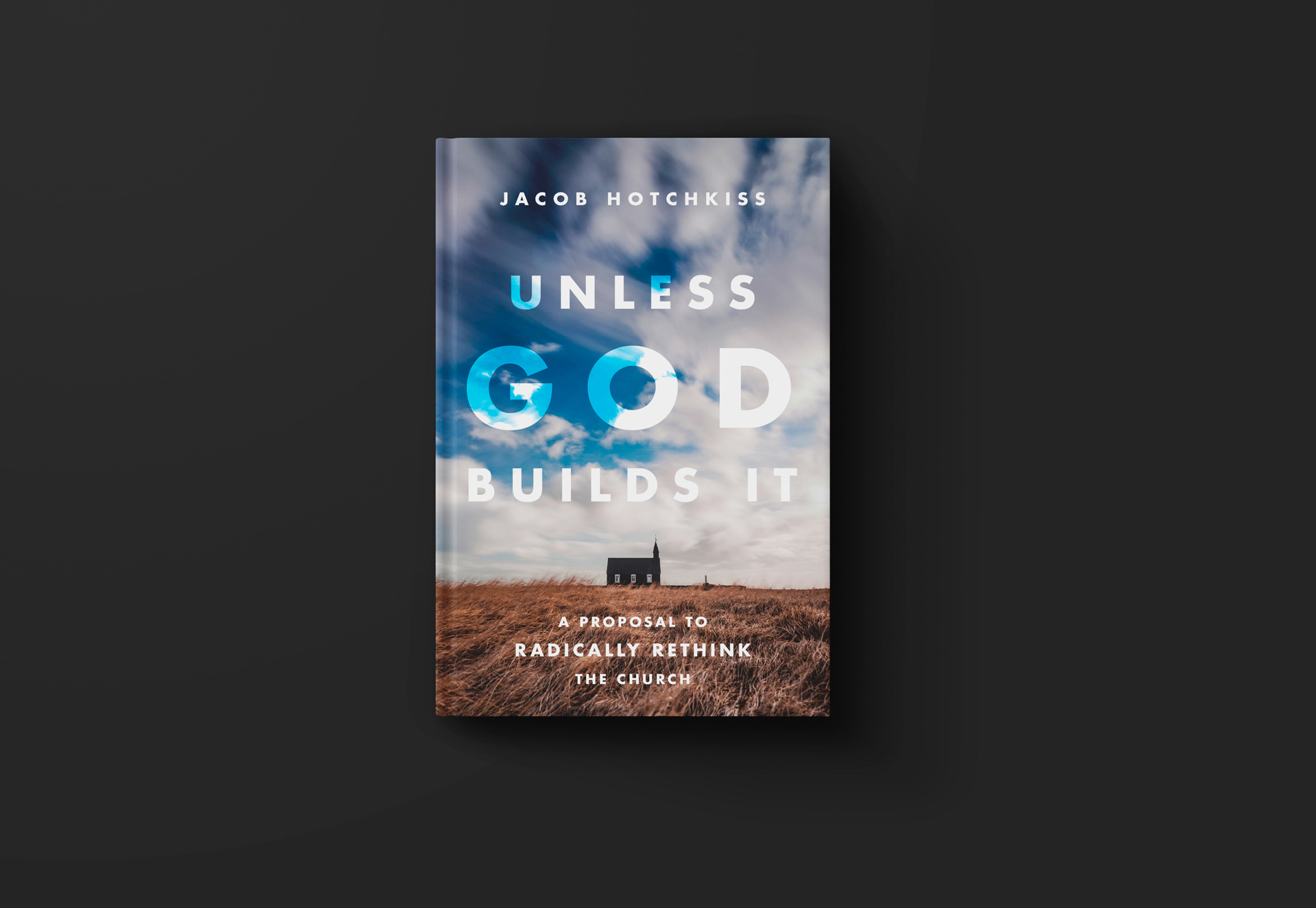
Welcome to Part 4 of the weekly release of my book, Unless God Builds It: A Proposal to Radically Rethink the Church.
Last week, we started Chapter 1 by questioning the sheer volume of resources we pour into church programs and asking if all this activity is actually producing disciples. I shared how I came to believe that much of our administrative busyness is in vain, and proposed a counterintuitive alternative: doing less.
If you have already read the book and do not wish to receive these weekly emails, simply click ‘Unsubscribe’ at the bottom of this email. It will only unsubscribe you from the Book section, and you will still receive my normal weekly newsletter!
Kill the Engines and Catch the Wind
Most churches today function like a cruise ship. God gives us a destination, and then we fire up our man-made engines, ripping through the waves without regard for the wind. “We’ll get there,” we reason, “because God has told us to go there and has given us the means to do so.” But days turn into months, months turn into years, and it’s questionable whether or not we’ve arrived. Yet we continue to burn fuel and pay the crew, believing we’re accomplishing something.
Don’t get me wrong—God has indeed given us a destination and the means for getting there. However, the part we’ve missed is that the means for getting there are not the engines (which we can start at will) but the wind (which we cannot control). Thus, his design for the Church is not to be a cruise ship but a sailboat, which has no other option than to put up its sails and wait for the wind to blow.
In this analogy, the “wind,” of course, is the Holy Spirit, who blows wherever he wishes (John 3:8), and the “engines” are all the ways and wisdom that we employ apart from the Spirit because it feels more productive than waiting on the Lord.
Our propensity to rely on our own ideas and abilities (or “engines”) to get somewhere can be seen in nearly every area of the Church. For example, we know we need to learn the Scriptures (a good and godly destination), so we implement a church calendar (engine) that ensures we preach through the whole Bible in a certain order over time. We desire our gatherings to be orderly and productive (another godly goal), so we use a pre-scripted agenda (engine) that we can print out on bulletins and only allow a few people to do the talking/singing. We need a way to minister to the influx of new people coming in (who can deny that this is a good thing?), so we add another Sunday service or build a satellite campus (a man-made engine). We need to raise money for our new expansion project (questionable goal, in my opinion), so it’s about time for the semi-annual tithing sermon (another engine). We want to protect our doctrine and maintain unity (hallelujah!), so we create/join a denomination and publish a statement of faith (engine). Hospitality is something to be desired (a biblical ideal), so we form a team of hospitality volunteers (engine) who make people feel welcome. It’s important that our kids are raised in the faith (true!), so we start kids and youth ministries (engines). The list goes on.
Perhaps you’re thinking: Is there something wrong with these methods? Aren’t they helpful? What are we supposed to do instead?
Well, let me just say this: There is actually another way of going about achieving these goals, which strikingly few seem to have entertained, yet is more explicitly biblical than anything listed above. That Way is the Spirit of God moving powerfully through individuals who rely on him. That Way is the long, slow, highly relational, and extremely humbling process of training people how to walk by the Spirit, to build each other up, to be empowered by Christ in all that they do. Try to do this with even one individual (beginning with yourself), using the fruits of the Spirit as your indicator for success, and you’ll come to realize how much you truly need God to bring about this growth, and how foolish it is to think that these engines can get us there. Hence, the need for prayer.
You see, the problem with engines is that they’re deceivingly “productive.” They seem to be the quick and obvious answer to our real-world problems. As such, it may even seem foolish or neglectful not to use them. However, what they almost always fail to produce is a people who are driven by the Wind, which is the whole point of this thing called “Christianity.”
You could use all the engines listed above, and you might end up with some people who are driven by the Wind. But if you focus on teaching people to catch the Wind—i.e., to rely on God in all things—then you are bound for every glorious destination to which he has promised to take us. The Spirit himself, in his perfect wisdom, will use each member as he wills to generate more power than a million engines ever could.
On the “sailboat,” hospitality isn’t the product of a “hospitality ministry” but of people who have matured in Christ and genuinely care about making others feel loved. Sound doctrine doesn’t depend on a statement of faith but on a community of believers who have learned to discern the voice of the Lord, who leads them into all truth. Our youth being raised in the Lord doesn’t depend on hiring a youth pastor and making sure to have tons of fun youth activities; it depends on parents being mature in the Lord and able to teach their children his ways. Taking care of people’s spiritual needs isn’t the result of more staff, more programs, and bigger buildings; it’s the result of more people understanding the power of the gospel, walking by the Spirit, and contending for the sanctification of those around them.
Here, on the “sailboat,” the Spirit of God (within each believer) does the heavy lifting. He does not depend on manufactured systems (which, let’s be honest, require a lot of maintenance by a small number of people), but on more and more followers of Christ operating not out of their own strength but his.
How God Gets the Glory
Too often, we mistakenly assume that if we don’t do something, it won’t happen (and/or that if we do something, it will happen). This is an “engine-building” mindset, which breeds self-reliance and restless action. The truth is, however, that if God doesn’t do something, it won’t happen (and/or if God does something, it will happen). This is a “sail-hoisting” mindset, which breeds God-reliance, rest, prayer, and faith. Hence, the following scripture:
Unless the Lord builds the house, those who build it labor in vain. Unless the Lord watches over the city, the watchman stays awake in vain. It is in vain that you rise up early and go late to rest, eating the bread of anxious toil; for he gives to his beloved sleep. (Psalm 127:1–2)
Let us make up our minds about it—God has promised to build his church, and we can trust him to do it! Jesus said to Peter, “[O]n this rock I will build my church…” (Matthew 16:18, my italics). The writer of Hebrews said, “For every house is built by someone, but the builder of all things is God” (Hebrews 3:3). The apostle Peter said, “[Y]ou yourselves like living stones are being built up as a spiritual house” (1 Peter 2:5). The apostle Paul said, “In [Christ] you also are being built together into a dwelling place for God by the Spirit” (Ephesians 2:22).
When King David finally found a bit of rest from his enemies, the first thing he thought to do was build a temple for God. He told the prophet Nathan of his ambitions, and Nathan affirmed him (presumptuously). But that night, God said to David, “Would you build me a house to dwell in?... [T]he LORD declares to you that the LORD will make you a house… I will raise up your offspring after you, who shall come from your body, and I will establish his kingdom. He shall build a house for my name…” (2 Samuel 7:5-13, my italics).
The Bible is clear on this fact. We are not the builders of God’s house. He is. And while he definitely intends to use us for this task, the only way we become useful to him is by relying on him, by depending solely on his Spirit, his wisdom, his strength. Hence, Jesus says: “Whoever abides in me and I in him, he it is that bears much fruit, for apart from me you can do nothing” (John 15:5). The scary thing is, we can actually do a lot apart from him, but it will be of no substance.
We therefore must come to terms with the futility of our self-supplied efforts and our human wisdom, no matter how good our intentions are. In Psalm 20:7, David wrote: “Some trust in chariots and some in horses, but we trust in the name of the LORD our God.” In the same way, we need to stop trusting in our “engines”—those things that make us feel and appear to be productive and powerful—and start trusting in our God. As Moses told the Israelites who had their backs against the Red Sea, “The LORD will fight for you, and you have only to be silent” (Exodus 14:14). Once we see this, we will strive for one thing—”to enter that rest” (Hebrews 4:10). We will finally be still and know that he is God (Psalm 46:10). From there, and there only, we will start to bear lasting, abundant fruit.
It’s here—in silence and rest, in abiding and waiting, in prayer and in faith—where God alone gets the glory, where no one can say that they built it, and no one can deny that God built it. We could argue all day about whether or not the Lord is the one who built your ministry or my ministry—whether he’s the one inspiring and empowering all the things we do—but there’s only one way to be sure: Stop. Rest. Wait. The only way to prove that God himself has been watching over the city is to put it in his hands and get your sleep. If you arise from your rest to find the city destroyed, then you’ll know that your labor was in vain, that the only thing keeping it together was your restlessness. But if you arise to find it holding together—and not only that, but flourishing—you’ll have greater confidence than ever before that God is truly the one watching over it.
Only by living this way can we look back on our lives, look back at what we’ve built and claim truly, “God built it”, for it is not humanly possible to keep watch over this size of a city or to build a house this spectacular, and to sleep the way we slept.
This is how God gets the glory.
It is not that we do it in our own strength and then dedicate it to God. It is not that we do it ourselves and then simply give credit to God, “humbly” ascribing it to him. It’s not even that we ask God to help us, and then go about doing it. It’s that, based on what we’ve witnessed, there is no other sensible conclusion than that God has done it. It’s that no human concept of what’s possible would describe what we’ve built. It’s that, in sheer appearance, as a matter of fact, an outsider must conclude that something they cannot explain has taken place.
That is how God gets the glory.
Man can build cathedrals, denominations, seminaries, and ministries of all kinds. Man can also write sermons, start podcasts, gain large followings, and organize their followers in various ways. If we’re honest, there is nothing about these things that inherently declares the glory of God, for there is nothing about them that necessarily requires the power of God.
But man himself cannot part the sea. Man himself cannot bring water from a rock. Man himself cannot defeat an army a hundred times greater in size. Man himself cannot raise the dead or turn water into wine. Man himself cannot give people new hearts, graft them into Christ, nor make the Body of Christ grow. That power belongs to God alone. Man sows and waters, but God gives the growth (1 Corinthians 3:7).
To desire the glory of God is to long for the impossible. It’s to desire to build something that cannot be built without the power of God. It’s to refuse to rely on one’s own strength—not out of laziness or apathy but out of zeal, understanding that there is no other way. There is only one way to become a thriving church, and that is to wait on the Lord.
This does not necessitate that we remain still (outwardly) forever—only long enough to see God beginning to move us. It isn’t that we should be against doing things, only doing things in vain. And the only way to know that our work is not in vain, the only way to be sure that God himself is the one empowering it, is to kill the engines, making rest and prayer our constant disposition. Then, if the ship begins moving while we’re at rest, we will know it’s not us but the Spirit of God.
< Previous Part | Table of Contents | Next Part >
Questions for the Comments:
In the cruise ship vs. sailboat analogy, what are some of the “engines” you’ve seen churches construct to manufacture progress, and what happens when those engines run out of fuel?
Why do you think we are so afraid of stopping our activity and simply waiting on the Holy Spirit to move?
Want to discuss these topics with other like-minded believers? We regularly explore the theology of the Church, discipleship, and spiritual growth in our monthly Community Calls. It’s a great place to connect—upgrade to a paid subscription today to get access!
Like what you’re reading? You don’t have to wait for the next part. You can read the entire book right now in paperback, ebook, or audiobook format on Amazon. Buy ‘Unless God Builds It’ Here
In Christ,
Jake